
Buying a home EV charger looks simple until you start comparing charging speeds, electrical supply, solar integration, cables, smart features and installation requirements. The charger that looks best on paper may not be the right fit for your EV or your home.
That's why we built HomeChargerMatch — to help you avoid these 10 common mistakes and find the charger that actually suits your Australian home, car, and energy setup.
1. Choosing a charger before checking your EV's AC charging limit
A major point of confusion for new owners is the difference between how fast a charger can deliver power, and how fast a car can actually accept it. Every EV has an onboard AC charger acting as a bottleneck.
Most Australian EVs comfortably accept 7.4kW or 11kW AC — not 22kW. A 22kW wall charger will not force your vehicle to charge faster if its onboard hardware is limited to 7.4kW. Always check your specific vehicle's charging limits before upgrading your electrical infrastructure.
The charger should fit the car, not the other way around.
2. Assuming a 22 kW charger is automatically better than a 7 kW charger
It's easy to look at the numbers and assume bigger is better. However, a typical 22kW AC charging setup inherently requires three-phase power.
A charger rated at 22kW cannot magically deliver 22kW from a normal single-phase household supply. In a single-phase home, it will be limited to 7.4kW anyway. If your home isn't wired for three-phase, or your EV only accepts 7.4kW, you are paying a premium for unused capacity.
Only pay for high-capacity charging if your home and car can actually use it.
3. Buying a charger without checking your home's electrical setup
Most Australian homes run on a standard single-phase power supply. Three-phase power is far less common in residential suburbs and often requires an expensive grid upgrade to install.
Beyond phases, your main switchboard capacity and available physical space matter just as much as the charger's technical specs. If your switchboard is old or already maxed out by an induction cooktop and ducted air-conditioning, a high-powered EV charger might cause nuisance tripping.
This is one reason HomeChargerMatch asks about your home's electrical supply before recommending a charger.
4. Paying for smart features you won't actually use
The modern EV charger market is filled with Wi-Fi, Bluetooth, RFID, and app-connected smart chargers. While these are fantastic for tech enthusiasts, they add complexity and cost.
Load balancing is highly valuable in older Australian homes with limited switchboard capacity, preventing blown fuses. Open Charge Point Protocol (OCPP) is worth considering if you want ultimate future flexibility with energy retailers or home batteries. But if you just want to plug in and charge overnight, a basic charger is perfectly fine. Don't pay for features you won't use.
Match the charger's intelligence to your actual daily routine.
5. Assuming every solar-compatible charger works the same way
Australia leads the world in rooftop solar. Naturally, buyers seek out solar-compatible chargers. However, simply having a solar array doesn't mean every charger will smoothly harvest your excess energy.
True solar surplus charging requires hardware like CT clamps or wireless energy monitoring devices to communicate with your switchboard. More importantly, if your car leaves home at 7 AM and returns at 6 PM, solar-matching features may be completely irrelevant to your lifestyle. Match the feature to your actual energy use.
Solar chargers are incredible — provided your car is actually home during the day to soak up the sun.
6. Forgetting about the charging cable
Cable length matters — especially in long, wide, or awkwardly shaped Australian driveways. A standard 5-metre cable might barely reach if you park nose-in when the port is on the rear quarter panel.
Furthermore, deciding between a tethered (built-in cable) and untethered (socket-only) unit impacts your daily routine. A tethered charger is highly convenient, while an untethered charger gives you aesthetic flexibility and future-proofing. Measure your exact parking position and distance to the wall before making a choice.
Measure twice, install once. Don't let a short cable dictate how you park your car.
7. Choosing a charger because it is popular or car-branded
Many new buyers simply default to the charger sold by their car dealership, assuming it's the only safe or optimal choice.
A car-branded charger may be perfectly suitable — but it isn't automatically the best option for your home. The EV charging market uses standardized plugs (Type 2 in Australia), meaning a third-party unit might offer better solar integration, longer cables, or a superior local warranty for a similar price. Compare based on compatibility, charging power, electrical requirements, and warranty — not blind brand loyalty.
Your car brand doesn't lock you into their charger brand. Explore your independent options.
8. Buying a charger without thinking about your next EV
EV hardware evolves quickly, but electrical infrastructure is relatively static. A high-quality charger can easily stay bolted to your garage wall for ten years or more, outlasting your current vehicle.
If you plan to add a second EV to your driveway, or eventually upgrade to a higher-AC-capacity model, consider future-proofing your installation now with a unit capable of load-sharing or higher outputs. Be strategic, but don't overpay for hypothetical needs that you may never realize.
Buy for the car you have today, but keep an eye on the garage of tomorrow.
9. Ignoring the installation before choosing the charger
The charger hardware is only one part of the project. The bulk of your expenditure and structural impact comes from the installation itself.
Installation complexity depends entirely on your switchboard location, cable run length, roof cavity access, and underlying electrical capacity. Buying a sophisticated charger online without consulting a professional first can lead to nasty surprises if your home requires major electrical upgrades to support it. A licensed Australian electrician should assess your home setup to ensure compatibility.
A premium charger is useless without a safe, compliant, and capable electrical foundation.
10. Comparing chargers by specifications instead of by fit
It is incredibly common to pull up a comparison spreadsheet and pick the charger with the longest list of features and the highest kW output. But an EV charger isn't "best" in isolation. It is only best for a particular situation.
The straightforward, tethered wallbox that makes perfect sense for a Tesla owner with single-phase power may not be ideal for a BYD owner with three-phase power, an extensive solar array, and a dynamic home energy management system.
Stop looking for the "best" charger on the market. Start looking for the best charger for you.
So, What EV Charger Should You Buy?
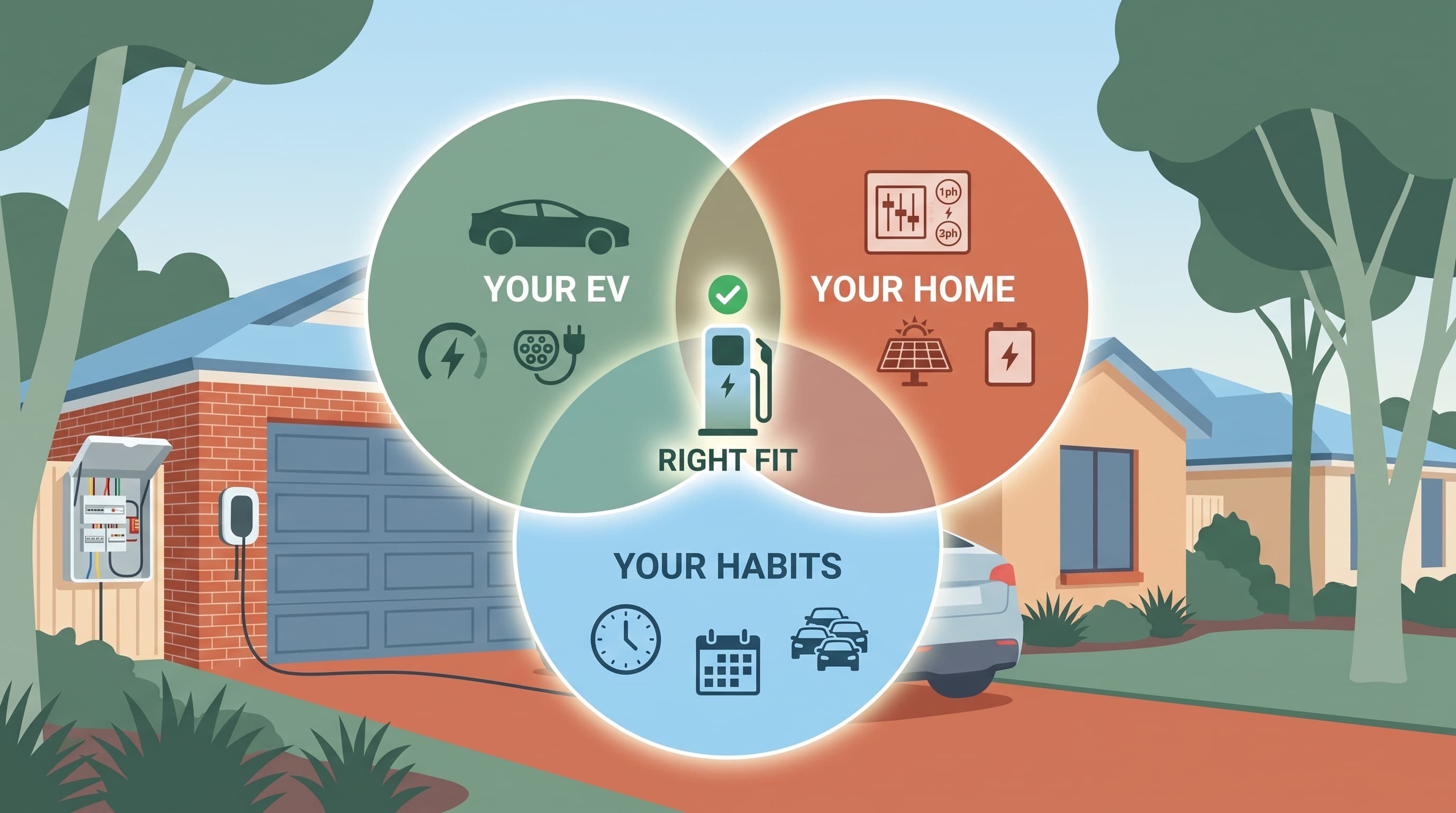
- Your EV: Maximum AC charging rate, charging connector compatibility, future vehicle plans
- Your home: Single-phase or three-phase supply, switchboard capacity, available space
- Your energy setup: Solar, battery, charging habits (overnight, daytime, etc.)
- Your charging habits: Daily driving, multiple EVs, need for speed
The right charger is the intersection of your car, electrical supply, energy setup and charging behaviour.
The Easier Way to Find the Right EV Charger
You don't need to become an EV charging expert. That's why we built HomeChargerMatch — to ask the right questions and match you with chargers that fit your Australian home and EV.
Find My Charger →Independent. Australian-focused. Free to compare.
Quick EV Charger Buying Checklist
- Your EV’s maximum AC charging rate
- Single-phase or three-phase home supply
- Your switchboard and available electrical capacity
- Charger location and cable length
- Solar and battery setup
- Whether solar charging is actually useful for you
- Features you will genuinely use
- Future EV plans
- Installation requirements
- Total value for your particular situation
Frequently Asked Questions
Don't buy an EV charger because someone tells you it's the best. Buy one because it is the right fit for your EV, your home and the way you actually use energy. That's the HCM way.
Find My Charger →